Polonius and Laertes are walking briskly in King Hamlet's glorious castle, the two are in the middle of a debate about the Roman Empire when the scene starts. Ophelia is following behind them quiet and respectful.
Laertes: My lord, I mean no disrespect to your opinion but this is fact. I have learned this through years of schooling, the empire fell in 457 A.D. - I am sure of it!
Polonius: Ah, my son. you are as obstinate as your mother. You simply do not remember the date correctly. The Roman Empire fell in 500 A.D. and this is the truth.
Laertes: My memory is as clear as this summer's day!
Polonius: Tis a shame, for you are still mistaken.
Ophelia: My lord, you are both mistaken, the Roman Empire fell in 476 A.D.
Polonius abruptly stops and looks at Ophelia with intense anger.
Polonius: Did I ask you to speak? Ah, Laertes as if a woman would know of such thing!
The two continue down the hallway laughing loudly as Ophelia sneaks off to a nearby open window. Her absence goes without any notice. She takes a risk and sits on the ledge with her feet dangling. Feeling hurt and insignificant she loses herself in a daydream when suddenly two hands grab her waist and push her but pull her back on the ledge. Ophelia screams.
Ophelia: My God! Is it my life you seek?!
Hamlet: No, just a laugh.
Ophelia turns to see Hamlet smiling widely over her shoulder, she can not help but laugh and turns to face him.
Ophelia: You almost scared me to death!
Hamlet: It was only for fun dear Ophelia, and to remind you how precious life is.
Ophelia: Well you have certainly succeeded.
Hamlet: I do not remember the last time we were alone together, has it been a year or more?
Ophelia: Nonsense, I see you almost every week!
Hamlet: But when is the last time we have talked about our innermost thoughts? What happened to our friendship, Ophelia? I only see you now fleetingly and only hear you when you are saying hello. I almost did not even recognize this beautiful girl sitting on the window.
Ophelia: I have been warned of you, Hamlet.
Hamlet: Do I mean to harm your life?
Ophelia: No, my lord.
Hamlet: Do I mean to hurt your family?
Ophelia: No, my lord.
Hamlet: Then where is the danger?
Ophelia: I do not know, my lord.
Hamlet: Look! Ophelia, look out at those daisies just beyond this window, do they not remind you of me?
Ophelia: Hamlet, that was years ago. We were not yet 7 years of age!
Hamlet: But you remember! That was where my lips first kissed any other, where they met yours. Ah, what an innocent age. I had not yet known what love is, but was already beginning to feel it.
Ophelia: Yes, but it we were just foolish children.
Hamlet: Foolish? Children are pure and true. Foolish, Ophelia? No, we were in love. And you cannot deny that we still are.
Ophelia: How could it be the same after all these years?
Hamlet: Just as I have grown, so has my love.
Hamlet leans closer to Ophelia.
Ophelia: My father would not approve of this.
Hamlet: But what does your father approve of? He is too concerned with Laertes to even care. Why listen to Polonius and not your own heart?
Ophelia: You are very convincing my lord.
Hamlet: Ha! Does that mean you agree?
Ophelia: I agree that we were in love, and that I should listen to my own heart. I can make my own choices and will start this very minute!
Hamlet:: Come Ophelia, let us relive the past.
Hamlet kisses Ophelia passionately.
Sunday, March 25, 2012

Wednesday, January 11, 2012
Colors in Chapter 9
"I though of Gatsby's wonder when he first picked out the green light at the end of Daisy's dock. He had come a long way to this blue lawn and his dream must have seemed so close that he could hardly fail to grasp it. He did not know that it was already behind him, somewhere back in that vast obscurity beyond the city, where the dark fields of the republic rolled under the night.
Gatsby believed in the green light, the orgastic future that year by year receded before us."(189)
The green light that has followed us throughout the book has gone from representing Gatsby's unrequited love, to hope, vitality and life. Now, we learn another meaning of the green light - "the orgastic future." Gatsby would stand out in the dark night, looking at the light which cradled all of his will and hope.
Another note would be the "blue lawns" - blue can symbolize one of two things - depression and sadness or Gatsby's deeply romantic dreams and illusions. For me, it represents both. We saw a lot of blue around Gatsby in the book, whether it be in is house or on his servants and I think that emphasized that his wealth was all part of his dream to "woo" Daisy. The blue lawns, could also be referring to the depressing setting of Gatsby's house. The parties were not enjoyable unless you were drunk, and the last one had a hostile, rude atmosphere. Gatsby's house was not full of life, because he himself was empty.
Tuesday, January 3, 2012
Locations in Chapter 7
Chapter 7 is a really crucial chapter in the book that pretty much sets in place the events that lead up to the shocking ending.
Gatsby, Jordan, and Nick go over to the Buchanan's house for a lunch, but later decide to go into town, on the way stopping at Wilson's garage. While in the city, because of the unbearably heat they check into a room in the Plaza Hotel. (which is the only new location introduced in this chapter) It is in the Plaza where the affair between Gatsby and Daisy is revealed out into the open. Gatsby and Tom proceed to fight over Daisy in a very tense and dramatic scene. I think this happened while in a suite in the Plaza because it's such a perfect, pristine place and it's ironic that their "perfect and pristine" lives were unraveling right in its very rooms. Underneath them they could hear music and a party taking place which contrasted the awkward fighting in their suite. Their wealth changed nothing about the secrecy and immortality in their lives; lying beneath it all they were still ordinary people. Even standing in one of the most famous hotels in New York City, could not change what they had done or felt.

Gatsby, Jordan, and Nick go over to the Buchanan's house for a lunch, but later decide to go into town, on the way stopping at Wilson's garage. While in the city, because of the unbearably heat they check into a room in the Plaza Hotel. (which is the only new location introduced in this chapter) It is in the Plaza where the affair between Gatsby and Daisy is revealed out into the open. Gatsby and Tom proceed to fight over Daisy in a very tense and dramatic scene. I think this happened while in a suite in the Plaza because it's such a perfect, pristine place and it's ironic that their "perfect and pristine" lives were unraveling right in its very rooms. Underneath them they could hear music and a party taking place which contrasted the awkward fighting in their suite. Their wealth changed nothing about the secrecy and immortality in their lives; lying beneath it all they were still ordinary people. Even standing in one of the most famous hotels in New York City, could not change what they had done or felt.

Monday, January 2, 2012
Themes in Chapter 4
The immortality of the 1920's and the American Dream are shown subtly in this chapter.
American Dream - Gatsby explained to Nick about the time before the war, he said, "I lived like a young rajah in all the capitals of Europe - Paris, Venice, Rome - collecting jewels, chiefly rubies, hunting big game, painting a little, things for myself only, and trying to forget something very sad that had happened long ago." (pg.70) This shows how Gatsby was somewhat living the dream, he was traveling and living without a care. He was filthy rich, young, and living extravagantly. He becomes a decorated war hero, representing bravery and integrity and all things "American." Then later on in the chapter, as Gatsby and Nick are driving, Nick describes the city "in its first wild promise of all the mystery and the beauty in the world." (pg. 73) This shows why people, including Nick, moved out east. For the lure of the American Dream and the promise of wealth and adventure. But this quote also gives the connotation that that's not what the city is; that there's a deeper, darker truth within its streets.
Immortality - There are little things that show the immortality, for example, Gatsby used his connections and past to get out of a simple ticket. And we also meet a man, Mr. Wolfsheim, a man who turns out to be a gambler who fixed the 1919 World Series. It would have been distasteful to have interacted with a man of such sorts, but Gatsby reveres him and finds him good company. Wolfsheim assumes Nick is a man who wants to do business, and we see a glimpse of an abruptness in him. When he learns of his mistake, he relaxes and continues merrily. To me, this shows how underneath the easy-going, care free of the 20's there was corruption and crime - and the two were intertwined.
American Dream - Gatsby explained to Nick about the time before the war, he said, "I lived like a young rajah in all the capitals of Europe - Paris, Venice, Rome - collecting jewels, chiefly rubies, hunting big game, painting a little, things for myself only, and trying to forget something very sad that had happened long ago." (pg.70) This shows how Gatsby was somewhat living the dream, he was traveling and living without a care. He was filthy rich, young, and living extravagantly. He becomes a decorated war hero, representing bravery and integrity and all things "American." Then later on in the chapter, as Gatsby and Nick are driving, Nick describes the city "in its first wild promise of all the mystery and the beauty in the world." (pg. 73) This shows why people, including Nick, moved out east. For the lure of the American Dream and the promise of wealth and adventure. But this quote also gives the connotation that that's not what the city is; that there's a deeper, darker truth within its streets.
Immortality - There are little things that show the immortality, for example, Gatsby used his connections and past to get out of a simple ticket. And we also meet a man, Mr. Wolfsheim, a man who turns out to be a gambler who fixed the 1919 World Series. It would have been distasteful to have interacted with a man of such sorts, but Gatsby reveres him and finds him good company. Wolfsheim assumes Nick is a man who wants to do business, and we see a glimpse of an abruptness in him. When he learns of his mistake, he relaxes and continues merrily. To me, this shows how underneath the easy-going, care free of the 20's there was corruption and crime - and the two were intertwined.
Thursday, December 15, 2011
Themes in Chapter 2
In Chapter 2, Nick meets Tom's mistress Myrtle and travels to the valley of ashes to get to New York City. I think that the valley of ashes contradicts The American Dream in this time period. He describes it as a place "where ashes take the forms of houses and chimneys and rising smoke and finally, with a transcendent effort, of men who move dimly and already crumbling through the powdery air." (pg.27) A poor, depressing place such as this is not the American dream, it's not wealth or paradise or success. It represents the complete opposite of what Nick moved out East for, and the complete opposite of what the book tries to portray.
In New York, Nick ends up partying until late into the night at Tom and Myrtle's apartment; Nick is repulsed yet drawn to the interesting people and characters. I think this chapter highlights the adulterous, superficial and self centered life style that Tom and Myrtle lead. It revealed the corruption of the 1920's. Now, I'm not saying that all were superficial and adulterous during this time period but traditions and rules were starting to be broken. Nick, who was only drunk twice in his life, got drunk during this chapter. I think that in itself almost represents how someone from a strong background and morals, could be tempted and corrupted - giving a bad connotation to Myrtle and Tom. It shows how the times were changing.
In New York, Nick ends up partying until late into the night at Tom and Myrtle's apartment; Nick is repulsed yet drawn to the interesting people and characters. I think this chapter highlights the adulterous, superficial and self centered life style that Tom and Myrtle lead. It revealed the corruption of the 1920's. Now, I'm not saying that all were superficial and adulterous during this time period but traditions and rules were starting to be broken. Nick, who was only drunk twice in his life, got drunk during this chapter. I think that in itself almost represents how someone from a strong background and morals, could be tempted and corrupted - giving a bad connotation to Myrtle and Tom. It shows how the times were changing.
Monday, December 12, 2011
Locations in Chapter 1
In Chapter 1, we are introduced to Nick's background and current life and location. He says that his family had been a prominent, well to do people in a middle-western city for multiple generations. It's in this chapter that the distinction between the Midwest and East come into play. "Instead of being warm center of the world the middle-west now seemed like the ragged edge of the universe - so I decided to go east and learn the bond business." (p.7)

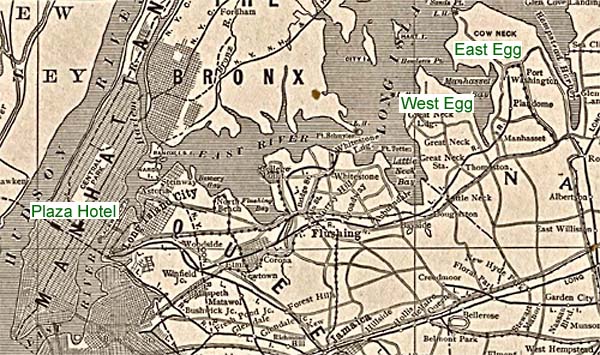
Once in New York, Nick describes where he lives, which he describes as one of the strangest communities in North America. I think this description immediately sets off the tone for the book and causes a hint of curiosity. Twenty miles due east of New York City were a pair of peculiar eggs. Now, at first, I actually thought he was talking about gigantic egg statues and was really confused. But in actuality, the eggs happen to be two land masses that resemble identical eggs separated by the Long Island Sound.
The "eggs" prove to be peculiar and essential to the story. Nick lives in West Egg, which he describes as the less fashionable of the two. It's home to new money and Gatsby. The values are different, the parties are grander and the tightness on funds is looser. East Egg, which is where Tom and Daisy live, is considered the more fashionable of the two. It's founded on old money and mainly revolves around status and education.
In my opinion, I think the eggs represent the changes in the 1920's time period. West Egg represents the new generation that is breaking away from the strict, obedient lifestyle of their parents. East Egg represents those who are still stern and proper and do not want to let go of old morals and traditions.
Wednesday, December 7, 2011
My Intial Reaction.
So far, surprsingly I actually really like the book. The 1920's is lively and interesting and I love the time period. I like how the story is being told and I like the style of writing by the author. It's not as complicated as other books we've had to read but it's still a challenge - which is good. The relationships and interactions make me want to keep reading and I can't wait to see what happens next. :)
Subscribe to:
Posts (Atom)